“Young online shoppers” is a useful demographic label, but a weak buying strategy. Two Vietnamese customers in the same age bracket can arrive at the same product for completely different reasons: one is deliberately comparing options, while the other discovers it through content and decides only after the product starts to feel relevant.
For a brand entering Vietnam, the useful question is not whether Gen Z or Millennials are “better” customers. It is what shopping situation the brand is entering, what makes the buyer hesitate, and which part of the journey still needs explanation before an order can happen.
The same generation can contain very different buying situations
A person buying skincare for themselves does not evaluate information in the same way as someone choosing a household appliance for a family. Income, who uses the product, who pays, how often it is bought and how costly a wrong choice feels can matter more than the generation label on a media plan.
Instead of asking what “young people” like, look at a specific purchase: what triggered the search, what alternatives were considered, what information was missing and what finally made the buyer comfortable enough to act. Those answers give SKYPERRY something concrete to use in market analysis and localization.
Discovery and purchase do not have to happen in the same channel
A customer may first notice a product in short-form content, look for reviews elsewhere and complete the order on a marketplace or brand site. Treating every platform as a self-contained funnel can hide what each channel is actually contributing.
The better commercial question is where the buyer needs discovery, comparison, reassurance and transaction. Shopee, TikTok Shop, a direct site and creator content can play different roles. SKYPERRY can design social-commerce and cross-border e-commerce activity around that buying path instead of copying the same campaign into every channel.
Trust changes with the product risk, not only with the buyer’s age
A low-risk purchase may need little more than a clear demonstration and an acceptable price. A product that affects health, appearance, family use or a larger household budget can require stronger proof, clearer seller information or more confidence in returns and support.
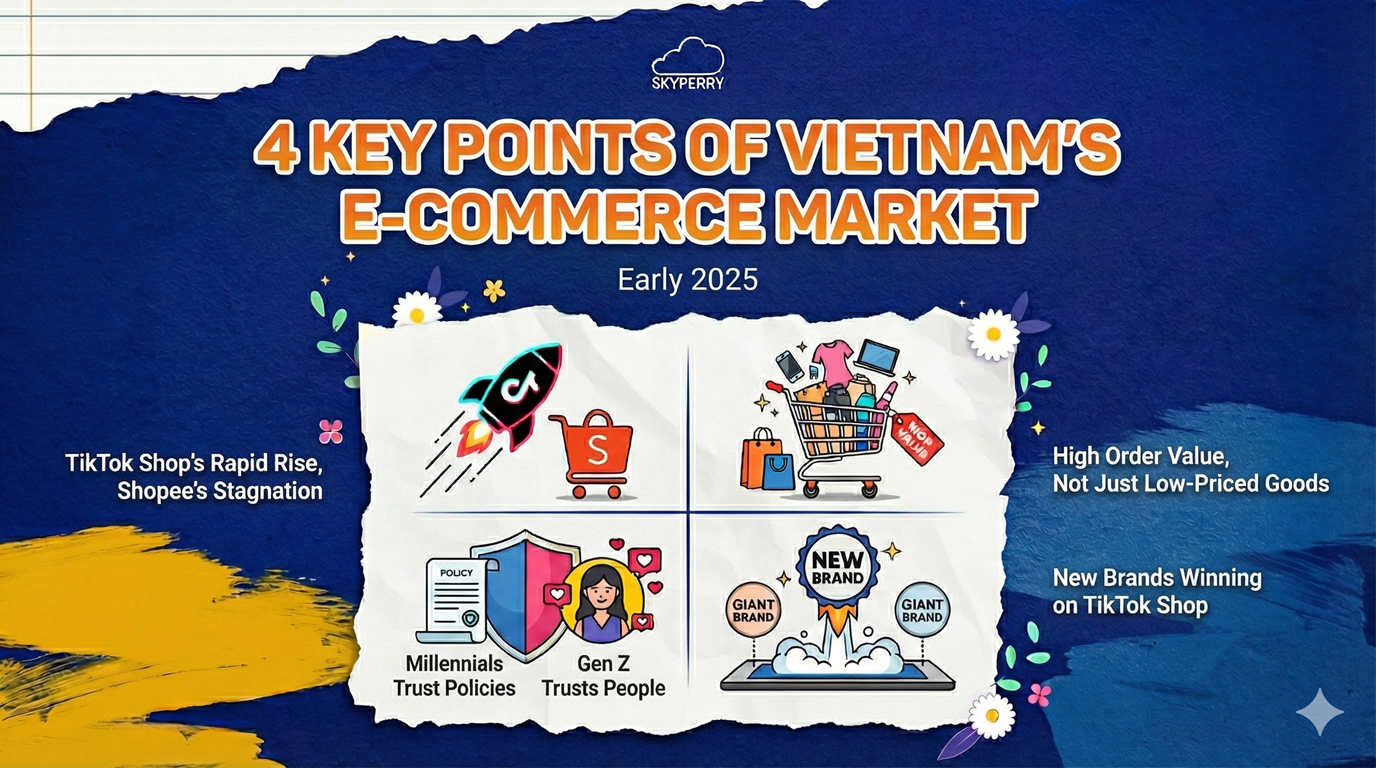
That is why a broad statement such as “Gen Z trusts people, Millennials trust policies” is too blunt for market-entry work. The brand needs to see what this buyer must believe about this product before paying.
A creator is useful when they remove a specific reason not to buy
A creator with a young audience is not automatically useful for a youth campaign. The stronger match is between the creator and the question blocking the purchase. One person may be good at demonstrating use; another may explain texture, fit, authenticity or a practical comparison in a way the intended customer understands.
This also makes the brief more accountable. The brand can judge whether the content answered the intended question instead of asking one creator to deliver reach, education, trust and sales at the same time.
A discount can make a weak channel look stronger than it is
Orders can increase because the message improved, because the channel reached the right buyer, or simply because the discount became difficult to refuse. Those are not the same commercial result. If the brand does not separate them, it may scale a channel whose performance disappears as soon as the promotion ends.
Look at completed orders together with platform deductions, content and creator costs, discounts, payment, fulfilment, cancellations, returns and customer service. Transaction volume alone does not make a channel sustainable.
The most useful signal is where interest turns into friction
Views show that content travelled. Product visits show that something attracted attention. The more useful market-entry learning often appears between that interest and the completed order: repeated questions, abandoned carts, failed payments, out-of-stock variants, delivery concerns, cancellations or returns.
Those frictions tell a brand entering Vietnam what to fix next—product explanation, localization, price, channel, stock or service. SKYPERRY can connect market and competitor analysis with brand localization, social commerce and cross-border e-commerce so a campaign teaches the brand how Vietnamese customers actually buy, not just how many people saw it.